indielinks

I haven't been posting much, this year. There are a few reasons for that, but the biggest is that I've been heads down on a personal project that I'm ready to make public. I'm calling it indielinks, and it can be described as "del.icio.us in the Fediverse". Of course, that's not helpful if one doesn't know what del.icio.us was, or what the Fediverse is.
del.icio.us
del.icio.us was a social bookmarking web service founded in 2003. You could upload your bookmarks, of course, but you could also follow other users and see & discuss what they were bookmarking. The site had leaderboards (most popular in the last hour, the last day, and so on, popular tags & like that) as well, and so it grew beyond bookmarking to become a means of content discovery.
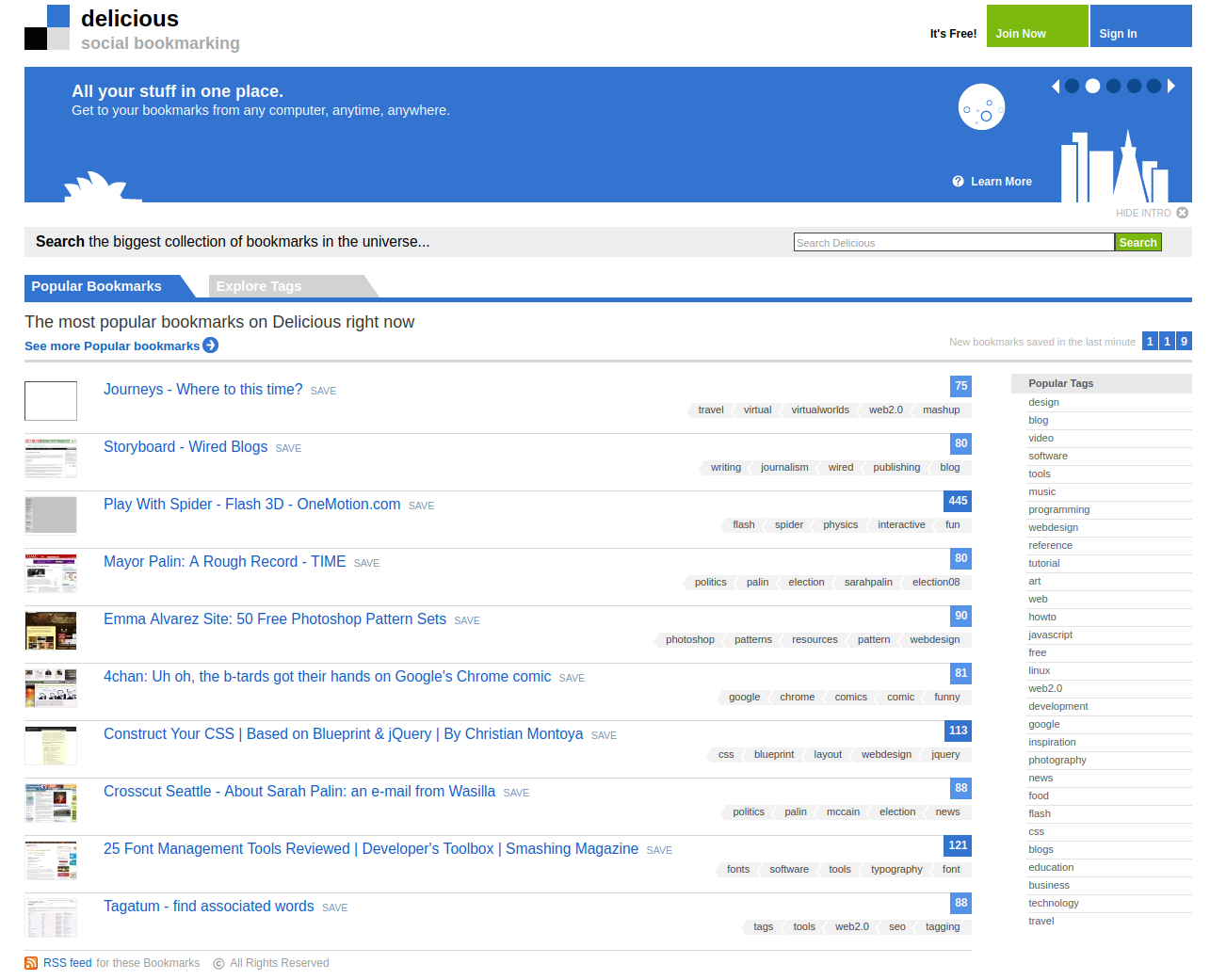
Figure 1: del.icio.us in 2008 (Wayback Machine)
It was acquired by Yahoo! in 2005, and claimed 5.3 million users by the end of 2008. Unfortunately, in 2010, a leaked Yahoo! memo seemed to indicate they were planning to shut the site down, leading to an exodus of users. The site went through multiple owners over the 'teens, eventually being shut-down for good in 2017.
The Fediverse
ActivityPub is a is a protocol for decentralized social networking. One can build social networking services on it in which multiple instances of your service federate with one another. Mastodon is probably the best-known such service: you don't sign-up at "mastodon.com"; rather your first step is to identify an instance you would like to join. Instances often form around a topic, or a location (e.g. I'm on indieweb.social, and there's a Portland instance). However, once you've signed-up, you're free to follow & generally interact with people on other instances. Should you find that your current instance no longer suits you, you can take your identity to another instance.
Furthermore, we can interact with people on other applications altogether; from Mastodon, I can follow someone on, say, Pixelfed (a photoblogging service, somewhat like Instagram) from Mastodon. When that person posts a new photo, that will show up in my Mastodon feed. Comments or likes in Mastodon will show-up on their Pixelfed page.
This somewhat rambunctious, non-siloed ecosystem is known as "the Fediverse":
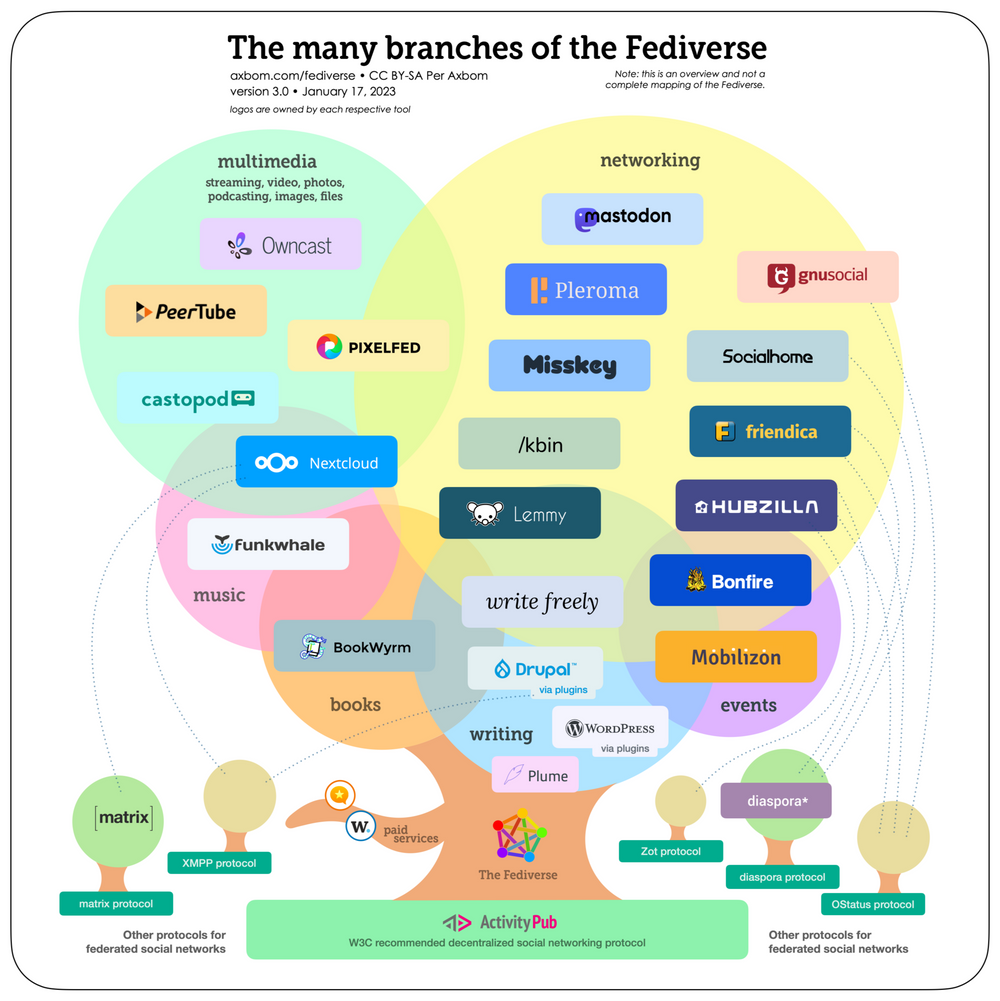
Figure 2: The Fediverse
indielinks
So when I describe indielinks as "del.icio.us in the Fediverse" I mean a federated service for social bookmarking that can interoperate with other apps that talk ActivityPub. Like del.icio.us, you can use it to upload & tag your bookmarks; here's my daily hacking reading list, for example:
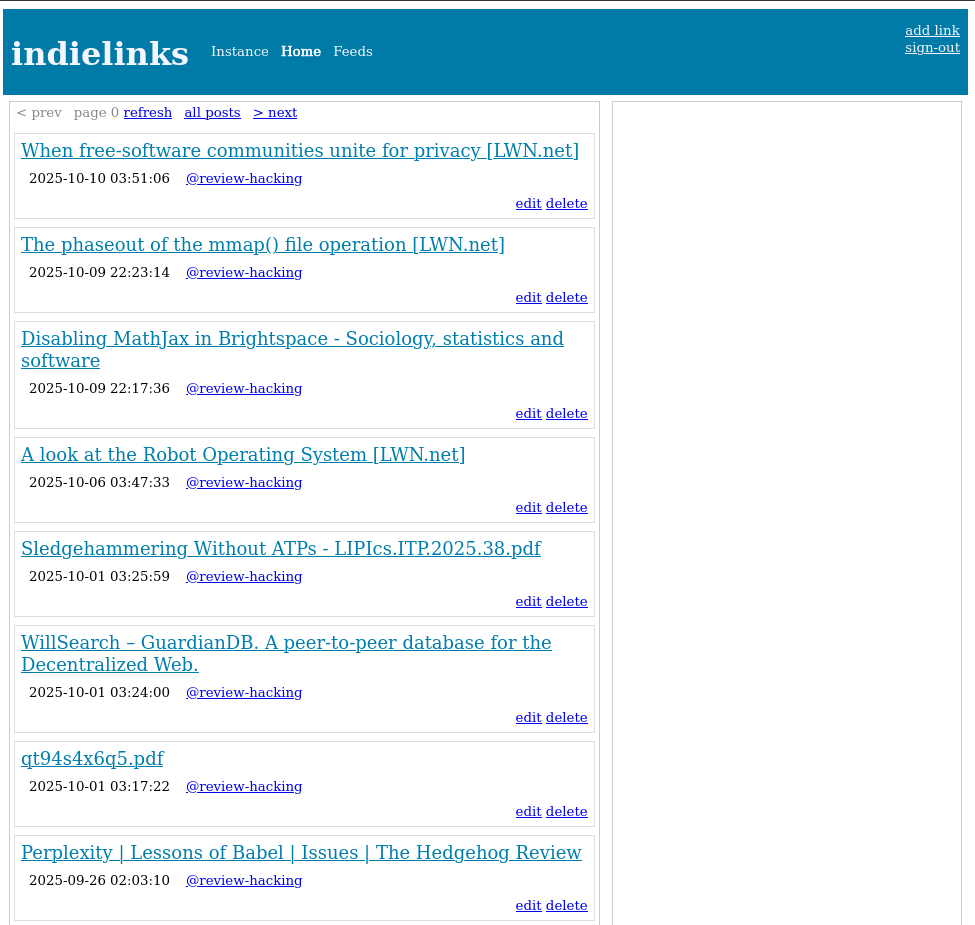
Figure 3: My "daily hacking" reading list
but, when you upload a public link…
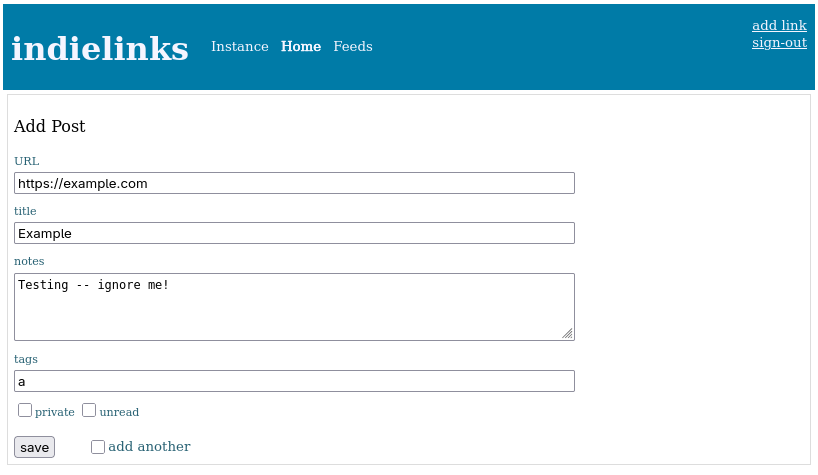
Figure 4: Adding a public link
your followers will see it in their feeds; here's that post showing-up in my Mastodon feed over at indieweb.social:
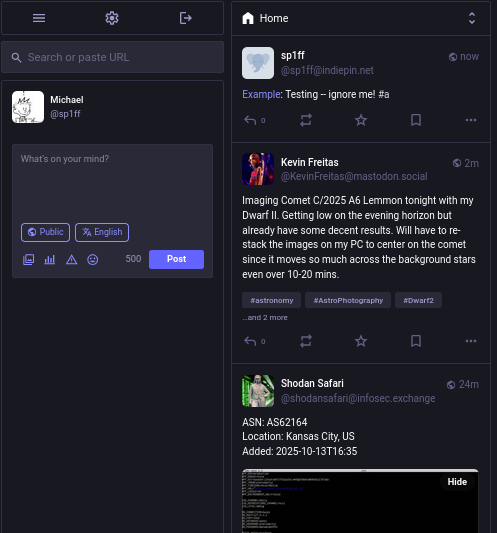
Figure 5: The link showing up in my indieweb.social timeline
Why indielinks?
The reader may wonder why.
At one level, I'm writing indielinks for the same reason behind so many open source projects: to scratch a personal itch. I'm a compulsive bookmarker. Today, I use Pinboard to maintain reading lists, keep references, and in general record my tagged, timestamped web history. Now, while I'm a happy Pinboard customer, it is nevertheless a closed-source, properietary, siloed service. The owner may at any time choose to shut it down, or sell it to someone else who will take it in a direction I don't like.
At a broader level, my hope is that indielinks can grow into a means of content discovery. Our current such systems are badly broken. Social media platforms are deep into the process Cory Doctorow called "enshittification": having locked-in users due to network effects, and having enticed content producers to abandon their own distribution mechanisms for their platforms, they no longer have much incentive to please either group. Not that they were ever particularly good channels for content discovery; in fact, they're incentivized to keep you from discovering interesting content across the web, but rather want you to stay on their site in order to sell more ads. But it gets worse: Twitter's manipulation of our timelines by hall monitors grown older has been thoroughly documented, while Facebook and Google have both recently admitted to censoring posts & search results. In their telling, this was done at the behest of the US government, but Google in particular has a history of demonitizing disfavored views and altering search results that predates the administration that they allege pressured them.
As part of the process of enshittification, social media services have been working to reduce the traffic they send to publishers for years. Of late, search engines have started presenting LLM-generated summaries at the top of their results, obviating the need to visit the sites that produced the training data for the LLMs in the first place. Publishers may at last be responding to this by re-building their own platforms & distribution mechanisms:
"I don't intend to ever rely on someone else's distribution ever again" --Nilay Patel (Editor-in-chief of The Verge)
"The platforms on which outlets like WIRED used to connect with readers, listeners, and viewers are failing in real time; Facebook traffic disappeared years ago, and now Google Search is dwindling as the company reorients users to rely on AI Overviews instead of links to credible publishers. More and more users are also skipping Google altogether, opting to use chatbots like ChatGPT or Claude to find information they once relied on news outlets for." – Katie Drummond, global editorial director of WIRED.
In an age of enshittification, hall monitors, and AI slop, we need new ways to find content, and my hope is that federated social bookmarking can be one such mechanism. What if you could get an RSS stream consisting of links with a given tag bundle posted by people you have judged interesting & reliable? What if you could search for content on a given topic and get results based on the interest expressed by human readers, rather than what Google's self-appointed censors judge to be safe for you to read?
Coming back to Doctorow, I differ with him in one important way: he sees government regulation as the solution to this problem, which I find unrealistic (especially since the government was one of the major drivers of our current state of affairs). Microsoft pretty-much lived in federal court through the mid-to-late nineties, with no discernable effect on their behavior– it was the rise of new tech that finally forced them to change.
Still, in his 2023 EFF post "As Platforms Decay, Let’s Put Users First", Doctorow lays-out two principles for a better web:
- End-to-End: Connecting Willing Listeners With Willing Speakers
- Right of Exit: Treating Bad Platforms As Damage and Routing Around Them
I'm fully on board with this, but rather than waiting for the government to mandate these principles, I say we should go ahead and build platforms for ourselves that incorporate them.
Status & Roadmap
All that said, it's still early days for indielinks; I haven't even stood-up the first instance, yet. I impetuously signed-up to present the project at the Vancouver Rust Meetup this week, and so I feel obligated to announce. I do, however, have working, useful code: I have been running a local, bare metal install side-by-side with Pinboard to maintain my links. Using CloudFlare tunnels, I've successfully federated with my Mastodon instance. My next focus will be getting Arch & Debian packages put together, so people can install locally & play with it.
After that, building-out the front end and getting it deployed to the web will be my primary focus. You can clone the repo on Github, and comments, complaints, suggestions & so forth are welcome here, in the issues, on Mastodon, and as always at sp1ff@pobox.com. Thanks for reading.
10/15/25 10:37